




Collect and Display Reviews Effectively to Sell More
Learn best practices for collecting and displaying customer reviews to enhance your shop's visibility, boost conversions, and build trust with shoppers.
Every year, the e-commerce industry experiences changes in consumer expectations, available technologies, and the way brands connect with their audiences.
Looking ahead to 2026, e-commerce is shaping up to be a more technological ecosystem, but also a more human one, focused on experience.
The winning brands will be those that:
✅ Use artificial intelligence to serve, not to manipulate;
✅ Offer personalised, entertaining, and sustainable shopping experiences;
✅ Focus on closeness, transparency, and trust.
To help you with this, below I’ve analysed the most relevant e-commerce trends in 2026. I will explain what they entail and what your online store can do to take advantage of them.
Users are expected to lean even more towards AI-powered searches as the technology becomes more familiar and accessible, thereby reducing users' reliance on traditional search engines like Google.
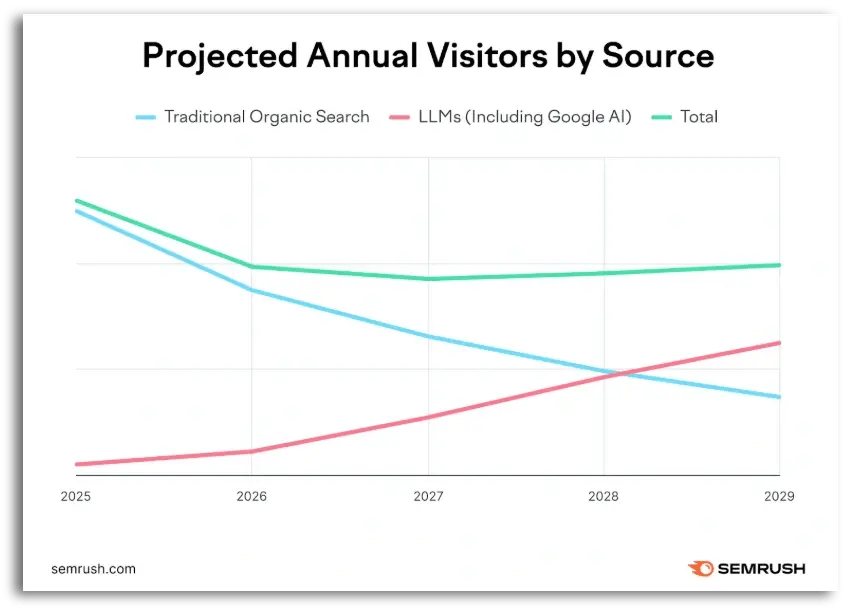
Source: Semrush
While it is true that more and more users are accessing ChatGPT & Co. to perform research, they still prefer conventional search engines to search for specific products or brands.
However, one of the great advantages of AI-powered searches over traditional organic searches is that visitors from ChatGPT & Co. tend to be better qualified, as most clicks come from in-depth conversations.
The good news is that AI search optimisation (also known as "Generative Engine Optimisation" or GEO) aligns with most traditional SEO best practices, which focus on:
We’ll conclude this section with an inspiring quote from Angel Travieso, CEO of Cajadecarton.es, which is related to the following trend.
Just as AI brings many advantages, it also has a dark side. Ever since its introduction to the market, the creation of fraudulent and fake content has not stopped growing.
Recommended reading:
Your Online Shop Looks Like a Fake Website
According to research by Visa:
To that end, more and more businesses across Europe are choosing to join the growing Community of Trust created by Trusted Shops: a space that has been connecting more than 32,000 authentic online stores with more than 45 million consumer memberships for over 25 years.
How does Trusted Shops prove the authenticity of stores?
 On the one hand, shops using the Trusted Shops platform are collecting verified customer reviews. On the other hand, shops can earn the Trusted Shops Trustmark to demonstrate their trustworthiness by collecting positive reviews and meeting a series of quality standards.
Shops that display the Trusted Shops Trustmark offer their shoppers a free Buyer Protection, which insures orders up to a value of €2,500 (or £2,500), thus guaranteeing a safe shopping experience and increasing the average order value.
Recommended reading:
The Trusted Shops Trustmark: How the Certification Process Works
Check out all the Trusted Shops success stories.
Want more details about our trust solutions? Contact our experts today for a free consultation:

Besides customer reviews and certificates, there are other ways to build trust in your online store. From an "About Us" page to clearly visible contact details and a wide variety of payment methods.

In 2026, we'll see online stores using AI to personalise the shopping experience. This will allow them to improve conversion rates, build customer loyalty, and reduce returns.
There are several ways to personalise the shopping experience with AI:
Amazon has launched Lens Live, an AI-powered feature that allows users to discover, compare, and purchase products in real-time by pointing their smartphone camera at objects in the physical world.

Source: Amazon News
💡 Imagine being able to personalise responses to your reviews with just one click! Trusted Shops' Smart Review Assistant is exactly what you need. This AI tool generates personalised responses to your reviews for you, saving you time and money.

In 2026, new regulations on packaging, product traceability, the circular economy, and other areas will be introduced.
Shutterstock/Mer_Studio
Among these is the implementation of “Digital Product Passports”, which will allow consumers to understand the complete life cycle of products, from their origin to the materials used, their environmental footprint, and end-of-life options. This information will be accessible via a QR code or electronic label.
Objective: To make products on the EU market more durable, repairable, reusable and recyclable, and to help consumers make more informed purchasing decisions by knowing a product's history and properties.
According to the DHL report, for 55% of buyers, the sustainable measures taken by companies will be more important in the coming years and will influence their purchasing decisions.
Challenges for businesses:
More and more brands are joining the sustainable movement and promoting transparency in their products through different strategies. Incorporating sustainability and transparency is no longer just a "nice-to-have," but a differentiating factor.
In 2026, e-commerce will be defined by the intelligent integration of technology, trust, and sustainability. AI, with ChatGPT and similar tools as the first point of contact, will change how users discover and purchase products, but its true value will lie in offering helpful, personalised, and transparent experiences.
In this context, trust becomes the key differentiator, driven by responsible data management, authentic user-generated content, and compliance with increasingly stringent European regulations.
Sustainability, far from being optional, will be a key requirement for brands selling in Europe. Brands that can connect these trends into a coherent strategy will be best positioned to build lasting relationships in the e-commerce industry of the future.
This article was translated and adapted from our Spanish-language blog: 5 tendencias clave en ecommerce en 2026
08/01/26



Paula works as the Content Manager for the Spanish market. Passionate about languages and e-commerce, she loves to write about news and trends in the world of online shopping. Paula is convinced that e-commerce will continue to revolutionise the global economy! In her personal life, she loves cooking and innovating in the kitchen!
Read more