



Collect and Display Reviews Effectively to Sell More
Learn best practices for collecting and displaying customer reviews to enhance your shop's visibility, boost conversions, and build trust with shoppers.
Online shoppers are moving from 10 blue links to a single conversational answer. When they ask for the best running shoes in ChatGPT or Perplexity, they get one clear pick with a few sources. No scrolling and guessing, just a recommendation.
This emerging channel is a great opportunity for e-commerce businesses. A few tactics can make your online shop visible in AI chatbots. Yet, it also means less passive exposure, less control over rankings, and a winner‑takes‑most dynamic where recommendable beats findable.
Here's everything you need to know about AI search visibility in e-commerce.
Table of Contents:
It's safe to say that AI tools have generated a great shift in buyer behaviour.
A study conducted by Nielsen Norman Group talks about how familiarity and ease of use impact search behaviour. Most people use Google as their search engine because it is the default option they're most familiar with. However, it shouldn't be surprising that searches in the form of a chat also feel so natural and intuitive.
When someone searches "best running shoes" on Google, they get ten blue links. They scroll, compare, and click what looks promising. The user makes the decision.
When they ask ChatGPT or Perplexity the same question, they get a direct answer with three to five specific sources. If anything is unclear, they can just ask a follow-up question. Here, the AI decides what is best for the user.
When talking about AI visibility, people usually refer to AI mentions.
AI mentions is when your online shop appears organically in AI chats, without needing to look it up on the internet. In other words, the AI pulls up this information "from memory".
AI search refers specifically to scenarios in which the user prompts the AI to search online for any (new) information it does not "know" yet. The AI pulls up this information from search results.
So, when the user asks for "the best running shoe brands", there's a high chance that ChatGPT or Gemini will mention their top 5 brands from memory, and you'll likely get the most popular brands.
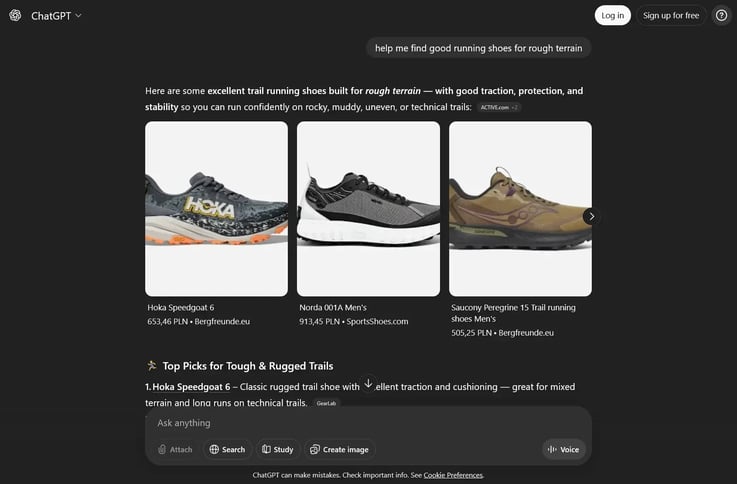
When the user asks, "Help me find good running shoes for rough terrain", there's a high chance that the AI chatbot they use will first search online before suggesting any product to the user.
In AI search, being findable does not equal being recommendable. To appear on the first page of Google results, you need to employ a set of SEO tactics, which boil down to:
AI search takes this into account, as it is still based on conventional search. For example, CoPilot uses Bing, and Gemini relies on Google. However, AI also has to decide what sources to use, and this is where a new layer of optimisation appears. AI looks for signals that suggest this is the page you want to recommend to the user.
When using AI search, buyers don't have to rely on specific queries or keywords like with traditional search. Instead, they can chat with AI about what they are looking for, and AI will decide what to search for based on the user's input.
A product recommendation from AI puts money on the line. If ChatGPT suggests three shops and yours isn't one of them, you've likely lost that sale to someone else. The question becomes: What makes AI pick one brand over another?
By now, you're probably well aware that AI chatbots and other tools affect the way people search for products. This poses a few risks for the visibility of your online shop.
In traditional search, you get brand exposure even without clicks. Let's say someone looks for "a mountain bike under $250". Even if they leave right after seeing the search results, there's a chance they have seen your name. Next time they see your brand, they'll recognise it – it will have become familiar, and thus, trustworthy.
AI search removes that passive visibility completely. Bain-Dynata survey shows that 80% of consumers rely on zero-click results with AI summaries for about 40% of their searches. It's safe to assume a good chunk of this is related directly to e-commerce, as reported AI referrals (traffic coming from AI tools) are growing by hundreds of percentage points year-over-year.
What does it mean for your website? In short, less traffic, fewer banner clicks, fewer upsell chances, and ultimately fewer sales – at least through the checkout on your page.
It's worth noting that many AI tools already implement native checkouts – an option to purchase products directly in the app, without having to enter any website. Google has released the Universal Commerce Protocol, which aims to provide a framework for online shops which want to implement AI native checkouts.
AI search does not follow the same rules as traditional search. Google search is (mostly) deterministic: you can predict and reproduce rankings using common SEO practices. In other words, there's a high chance that what worked for product A will also work for product B.
AI search is fundamentally non-deterministic. It generates results using parts of traditional SEO, but also semantic similarity, context, and, for many AI apps, also personalisation. So, the same user asking for the same product may get different results every single time.
It takes a lot of control out of your hands. There are tactics you should follow to appear in AI, but unlike traditional search, you can’t directly target rankings. Success comes from giving AI the right signals and letting it interpret them, rather than telling it exactly what to show.

Despite how good AI models seem compared to those from just one or two years ago, they still tend to give inaccurate results, or "hallucinate". AI models don't know anything for sure, which is why you may get an answer that sounds confident but is not actually true.
AI search is a remedy for this problem: the answer is based on what it can find online.
However, this poses another risk. If the data that AI finds on your website is incomplete or inaccurate, it may decide to show it only in additional sources or ignore it altogether. This is why you should always make sure all important information is accessible, up-to-date, and structured in a way AI can digest it easily.
Customer reviews are a good source of additional information that AI search apps can use to suggest products, especially for more specific requirements. They also need to be provided in a way AI can read them – for example, inside a review carousel widget.
AI search rewards brands that are easy to retrieve, safe to quote, and confident to recommend. In practice, you’re optimising for a pipeline. The model has to:
Here’s the part most teams miss: You don’t hack your way into AI answers. You remove friction from the AI’s decision-making, or simply make your shop easier to read than your competitors'.
In Google’s AI features, the baseline requirement is brutally simple: if a page can’t be indexed and shown with a snippet, it can’t be a supporting link in AI Overviews or AI Mode. Google spells this out directly in its guidance on AI features and your website.
Once you’re eligible, the next step is winning recommendation selection. In practice, AI search systems prefer sources that are easy to read, clearly attributable, and simple to verify. When an AI chatbot prepares an answer, grounding happens first and generation happens second.
Start with clarity. Make it clear who you are (as an organisation), what you offer (products/services), and which pages represent your truth (consistent naming, linking, identification). This reduces brand confusion and helps systems connect mentions to the right entity.
Then, make key sections extractable. In simpler terms, your content should use clean headings, lists, and direct explanations. Concise texts are easier to digest for AI than dense narrative paragraphs, especially in best X and comparison searches, where the AI is checking multiple sources.
Use schema as a tool, not a checkbox. A controlled test found that among three near-identical pages, the page with well-implemented schema was the only one that appeared in an AI Overview. This suggests that completeness and correctness matter more than simply using schema.
Across AI-driven search surfaces, online trust and reputation, such as reviews, mentions, and recognisable third‑party validation, show up as a recurring factor in whether brands get surfaced for recommendation prompts.
This is where many SEO strategies underperform: you can have great on-site content, but if the broader web has weak confirmation that you’re a safe bet, the model has little incentive to recommend you over a more trustworthy competitor.
The solution is to build your authority outside your website.
Every niche will have its own best options, but reviews on third-party websites, decent social media presence, and showing user-generated content are a good way to go.


Shutterstock/showcake
You can’t manage what you can’t see, so start by checking visibility the same way your customers do, then measure what’s realistically measurable.
The first test is simple. Open ChatGPT, Perplexity, or any other AI chatbot with search capabilities and try to find the product you offer by chatting with the AI. You can specify your price range, shipping region, or any other specific requirements.
If your page appears at least once in suggestions, great! It means AI can access your store. If your store never shows up across a handful of realistic chats, you can assume you’re invisible in AI-assisted product discovery.
The simplest approach is to pick a small set of 10–20 prompts your customers would realistically use and check them on a schedule. Therefore, you’re not relying on random one-off tests.
You likely want to automate this, though. There are tools that monitor AI Overviews and whether your domain is included among the cited sources. Bigger SEO platforms like SISTRIX, Ahrefs, and Semrush have added AI Overview tracking features alongside classic SEO reporting, which makes them convenient if you already use one of them.
Just keep expectations realistic: These trackers can't read AI search appearance data, because AI chatbots don't provide such data. In short, they regularly capture AI snapshots and compare what appears over time, which is exactly what you’d do manually, just at scale.
Separate your store mentions from visits!
A mention is when the AI names your store, but the user never clicks.
A visit is when the AI sends traffic to your site. Visits are measurable in standard analytics. Mentions usually aren’t.
When AI tools send a click and visit your online shop, you’ll likely see it in your analytics as referral or direct traffic.
Because of that, it is difficult to precisely attribute the traffic (unlike with traditional search). As such, you should treat it as the minimum confirmed number of AI search appearances.
AI search changes the rules, but it’s not all risk. While fewer clicks and AI-driven recommendations shift visibility, it also favours stores that are clear, easy to find, and trustworthy.
The good news is you don’t need to overhaul your website. Clear content, structured data, and up-to-date information, combined with a good online presence, are usually enough to get your store cited and recommended, making adoption easier than it might seem.
27/01/26