



Collect and Display Reviews Effectively to Sell More
Learn best practices for collecting and displaying customer reviews to enhance your shop's visibility, boost conversions, and build trust with shoppers.
UCP is a game-changer for e‑commerce businesses. The Universal Commerce Protocol (UCP) is a standard created by Google to enable Artifical Intelligence (AI) agents to interact with product catalogues and merchant systems in a reliable, secure, and standardised way.
Before UCP, AI in e‑commerce was limited to product recommendations and automated customer support. Today, it can manage the entire purchasing journey, provided your product data is reliable and standardised.
This transition marks the beginning of e‑commerce driven by agents, not just websites.
Table of contents:
With UCP, traditional search engine optimisation (SEO) evolves towards AEO – Answer/Agent Engine Optimisation:
Data optimisation is no longer just for search engines, but also for AI agents who sell directly for you.
According to Google, the universal commerce protocol:
A user might formulate the query:
“I am looking for a lightweight suitcase of XY size, at the best price, with delivery in two days.”
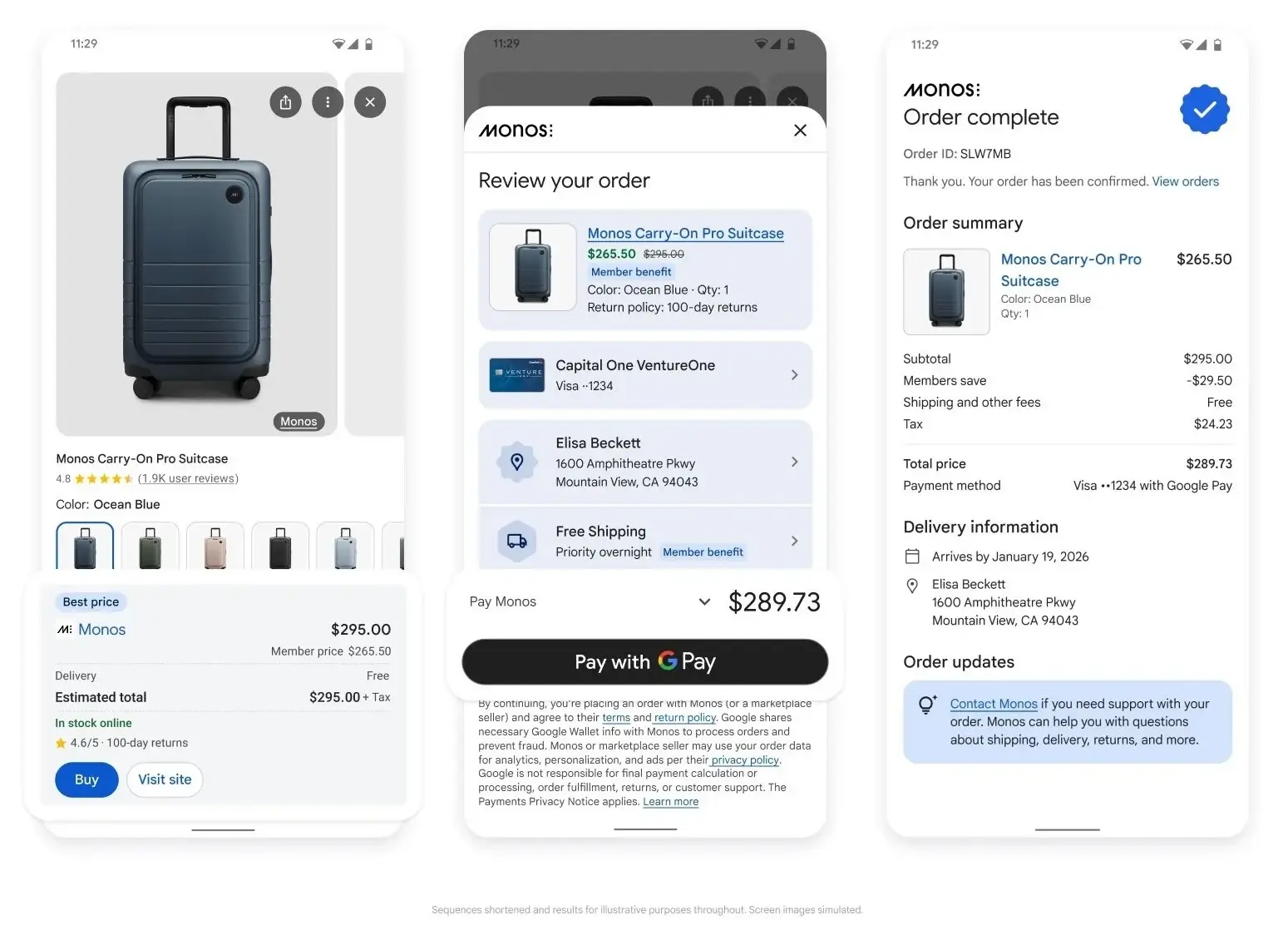
Source: Google
Thanks to the UCP, the AI agent:
There are benefits for the merchants as well:
To delve deeper into the technical workings, Google's official article details UCP: Under the Hood: Universal Commerce Protocol
Note: AI players like OpenAI and Perplexity have already offered native checkout solutions, making UCP an evolution rather than a disruptive innovation. Nevertheless, its main competitive advantage lies in its ability to address the entire e‑commerce funnel, from discovery to conversion and post-purchase. Furthermore, Google already has massive access to the merchant data of numerous e‑commerce sites, which should significantly reduce the complexity and cost of integration for most websites.

Google no longer just analyses your web pages; it evaluates the reliability of your catalogue.
To be properly understood and recommended by AI agents, your data must be consistent and reliable.
Even small inconsistencies can reduce an AI agent's ability to recommend your products, directly impacting your visibility and sales.

Shutterstock/Panchenko Vladimir
Modern CMS platforms (Shopify, WooCommerce, Magento, etc.) already centralise your data.
However, this does not automatically guarantee that:
Even with a high-performing CMS, it is essential to verify that your data is structured, exposed, and synchronised for AI agents.
💡 Is your e‑commerce business visible to AI? How can you appear in AI platform results and adapt to new customer expectations? Download your free whitepaper.

To strengthen credibility with customers and Google:
Trusted solutions like labels, authentic reviews and certifications (Trusted Shops) play a key role:
⚠️ They do not replace data consistency, but they reinforce it.
Recommended reading:
Trust Marketing: Building Confidence With Your Target Audience
Result: AI-readable data flows, better visibility, seamless customer experience.
Your products will then be understandable by AI and ready to be recommended when they are fully optimised.
UCP is not just a technical protocol. It translates the complexity of product catalogues into a language understandable by AI.
For e‑commerce businesses, having reliable, standardised, and synchronised data means:
Merchants who adopt UCP, organise their flows, and strengthen customer trust will remain competitive in the era of agentic commerce.'

This article was translated and adapted from our French blog: Google Universal Commerce Protocol : L'impact sur votre visibilité
21/01/26



Pauline has a degree in International Business from the University of Nantes. After working in B2C e-commerce for a major French mobile accessories company, in 2016, she joined a German agency specialising in the creation of e-commerce websites and web marketing strategies.
Read more