




Collect and Display Reviews Effectively to Sell More
Learn best practices for collecting and displaying customer reviews to enhance your shop's visibility, boost conversions, and build trust with shoppers.
AI simplifies your processes, but does it also strengthen your credibility as an online shop? Many things can go wrong when artificial intelligence is involved, which is why trust is becoming a valuable commodity in the age of artificial intelligence.
We’ve compiled 10 tips for you on how to remain recognisable and authentic as a company despite automation, chatbots, and other AI tools.
Table of contents:
In a world of machines, it's important to preserve the human touch. After all, humans are social beings. This renewed yearning for authenticity also extends to e‑commerce, because ultimately, shopping is a transaction between people.
In a world increasingly perceived as chaotic and confusing, consumers primarily desire peace and comfort. This was the finding of the study Top global consumer trends 2026 by Euromonitor International, published in November 2025:
58% of consumers experience moderate to extreme stress on a daily basis. Therefore, the study recommends that companies respond to this trend by focusing on products and services that build trust and simplify life.
This includes reducing unnecessary complexity and using artificial intelligence for a clearly identifiable purpose.
AI is therefore neither an end in itself nor a trendy "must-have", but only has a benefit for online shops if it is used in a targeted manner and addresses customer needs.
Sometimes, things go wrong when we overdo it with AI. Here are a few examples:
The term “AI slop” is becoming more and more popular around the internet. If you haven’t heard of the term before, it basically refers to the high number of low-quality texts, images, and videos produced using artificial intelligence.
This content clogs up the feeds on Facebook, Instagram, YouTube, and other platforms. Its sole purpose is to generate as many clicks as possible through sheer volume in order to generate advertising revenue.
At best, shallow AI garbage provides amusement. At worst, it destroys people's trust in digital content.
Chatbots are both a blessing and a curse on e‑commerce sites. They simplify workflows, reduce costs, and, in the best-case scenario, offer a straightforward solution. However, if they don't work as intended, they distract users and cause hindrances.
This ambivalence may explain why chatbots are not particularly popular: In case of a problem, 62% of online shoppers would prefer a human contact person, according to a 2025 Bitkom survey. Only 36% of respondents would be satisfied with a chatbot.
Good old-fashioned emails remain popular, with around half of those surveyed preferring it as a contact option in case of problems or questions.
Artificial intelligence makes our lives easier in many ways, but it can just as easily be used for fraudulent purposes.
Thousands of fake reviews or even completely fake online shops can be posted on the internet within seconds.
The danger is real: In the last two years, one in eight people has fallen victim to a fake website, as the consumer protection agency has discovered.
Recommended reading:
Your Online Shop Looks Like a Fake Website
Although things can go wrong with AI, there is still a lot you can do to make use of these tools. Here are 10 tips for using artificial intelligence in your online shop while still remaining trustworthy:
To ensure that humans and machines remain distinguishable, you should use AI transparently both in your shop and on social media. Clearly label it where confusion could arise.
This applies, for example, to images on social media that you have generated with AI or heavily edited. Similarly, it should be clear whether an AI agent or a member of your service team is behind chat windows.
Transparency in the use of artificial intelligence makes your company appear more reputable and thus increases the willingness to buy.
In this blog article about D2C brands, we used A.I. to help generate a featured image (and labelled it accordingly):

Showcase the various ways your customers can reach you prominently on your shop page. Don't leave all the work to the chatbots. As we mentioned above, only 36% of your customers like it.
It is particularly important to program the chatbot so that it quickly forwards problem cases to a human employee. There’s nothing worse than feeling misunderstood, especially by a robot!
A mix of different contact methods is the best option. Take the needs of your target audience into account.
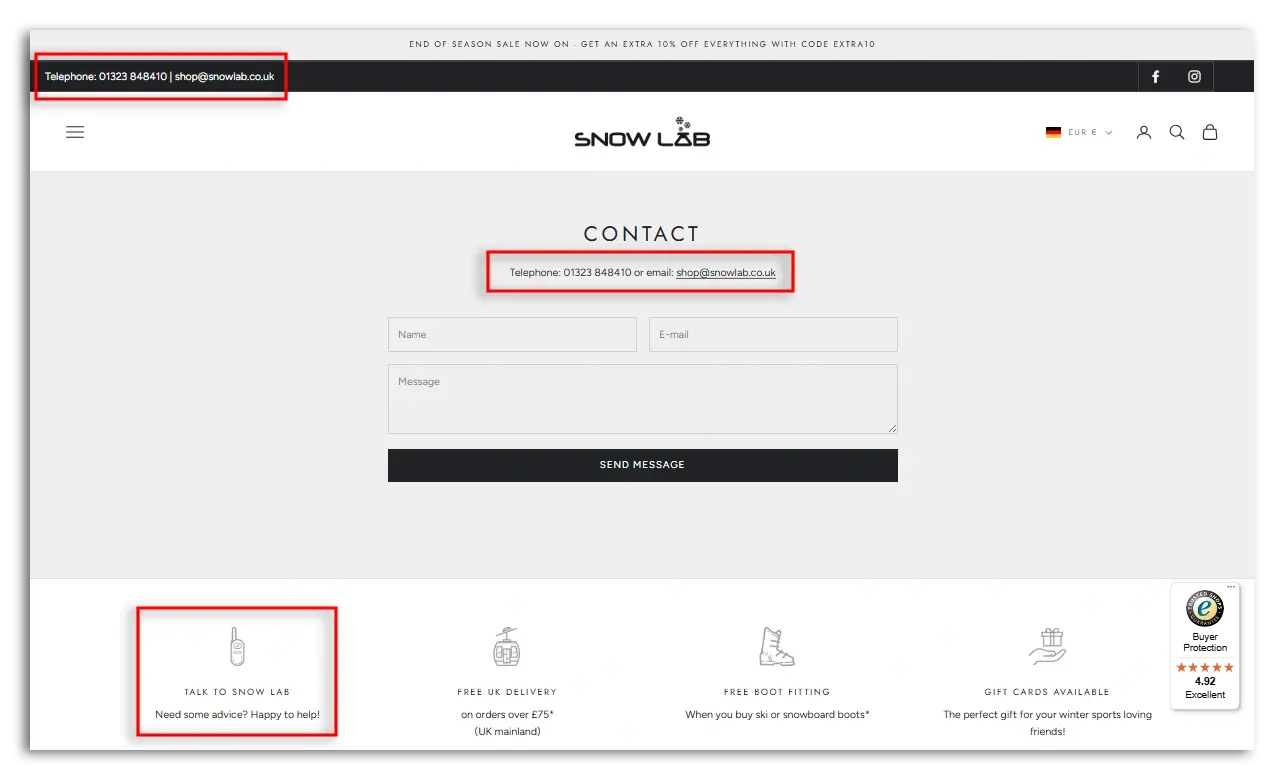
In this example, Snowlab offers visitors the option to contact them via a form, email or phone number, which are all clearly visible on the website.
Don't let AI create all the text on your shop page, especially product descriptions. Common tools like ChatGPT and Copilot are useful for research, topic selection, and initial drafts, but the final version should be written and/or proofread by a human.
Personalised texts stand out pleasantly from the monotonous, robot-generated content. This not only makes your texts more appealing to humans but also increases your visibility for search engines and AI agents.
"AI and search engines prioritise sites that demonstrate depth, structure, and clear expertise over thin, single-keyword pages," as the study "Digital Marketing Trends in 2026" by NP Digital succinctly puts it.
Recommended reading:
How Trusted Shops Strengthens AI visibility for Your Online Shop
Social media is the perfect place to showcase your company's human side. Post high-quality images, ideally ones you've created yourself. It's not about taking the perfect photo, but about conveying a feeling or mood.
Show what goes on behind the scenes, introduce your online shop staff, and publish pictures of your customers using your products (with their consent, of course).
These steps will help you remain recognisable and provide social proof that your company actually exists.
You should always respond to customer reviews published on your website or on online platforms, especially the negative ones. This publicly demonstrates your good customer service and shows that you have employees who are happy to help when problems arise.
Of course, AI can help you with this task. However, make sure to choose a tool that responds to each comment individually and in a varied way. Furthermore, you should always review the responses and check whether they meet your quality standards.
👉 Tip: With Trusted Shops' Smart Review Assistant, you can easily and individually respond to reviews with just a click of the mouse!

Product reviews not only reduce your return rate, but they're also user-generated content directly on your site. Both humans and bots appreciate authentic customer testimonials. This strengthens trust in your business and your products.
However, it is important to collect product reviews via a reputable third-party provider (like Trusted Shops). DIY solutions can raise suspicions, especially if you have a perfect rating. Potential customers might wonder if negative experiences are allowed to be shared.
The use of AI does not take place in a legal vacuum, but is subject to certain rules. Whether it's data protection or copyright, there are quite a few things to consider when using AI tools in your online shop.
It may be work to delve into the legal framework, but on the other hand, a professional appearance will earn you a great deal of trust, and thus more customers!
According to the aforementioned study, Top global consumer trends 2026, 50% of consumers want products and services that are uniquely tailored to them. AI, with its intelligent algorithms, offers you the opportunity to better meet this need.
However, avoid the feeling of being totally monitored. We all know that one product we clicked on somewhere, and that then follows us across social media and websites for the rest of our lives! Nobody wants that.
Use personalisation as a friendly reminder and invitation, not as an intrusive nuisance.
Recommended reading:
Personalising the E‑commerce Customer Journey
Follow the principle of "human on the outside, automated on the inside." As already described with chatbots, many customers are sceptical of overly obvious automation. Therefore, you should appear as human as possible to the outside world.

Shutterstock/charles taylor
However, behind the scenes, it's worthwhile to automate processes with AI. This can be done, for example, in inventory management, supply chain optimisation, or customer review analysis. This saves you time and money and also improves the user experience.
The most important tip of all: Always rely on human oversight for important decisions! This principle is called "Human in the Loop". Keep people involved in the process and don't blindly rely on technical applications where it matters most.
This means, for example, handling complicated complaints personally, never publishing AI-generated content without checking it, and verifying product data and prices.
Don't forget: Everything you publish on behalf of your online shop will be attributed to your company – no excuses! If the AI makes a mistake, it's your mistake. This can cost you valuable trust.

Is online retail still the future? Certainly, but sales channels will continue to evolve. One important trend is "agentic commerce," meaning shopping via AI agents that research and purchase products on demand. For online shops, it is therefore becoming increasingly important not only to have a website that appeals to people, but also one that can be found by AI agents.
Google recently took a significant step towards agentic commerce: The Universal Commerce Protocol (UCP) is a standard created by the search engine giant to enable AI systems to interact with product catalogues and e‑commerce platforms. This innovation offers online shops the opportunity to increase their visibility within the Google ecosystem and beyond.
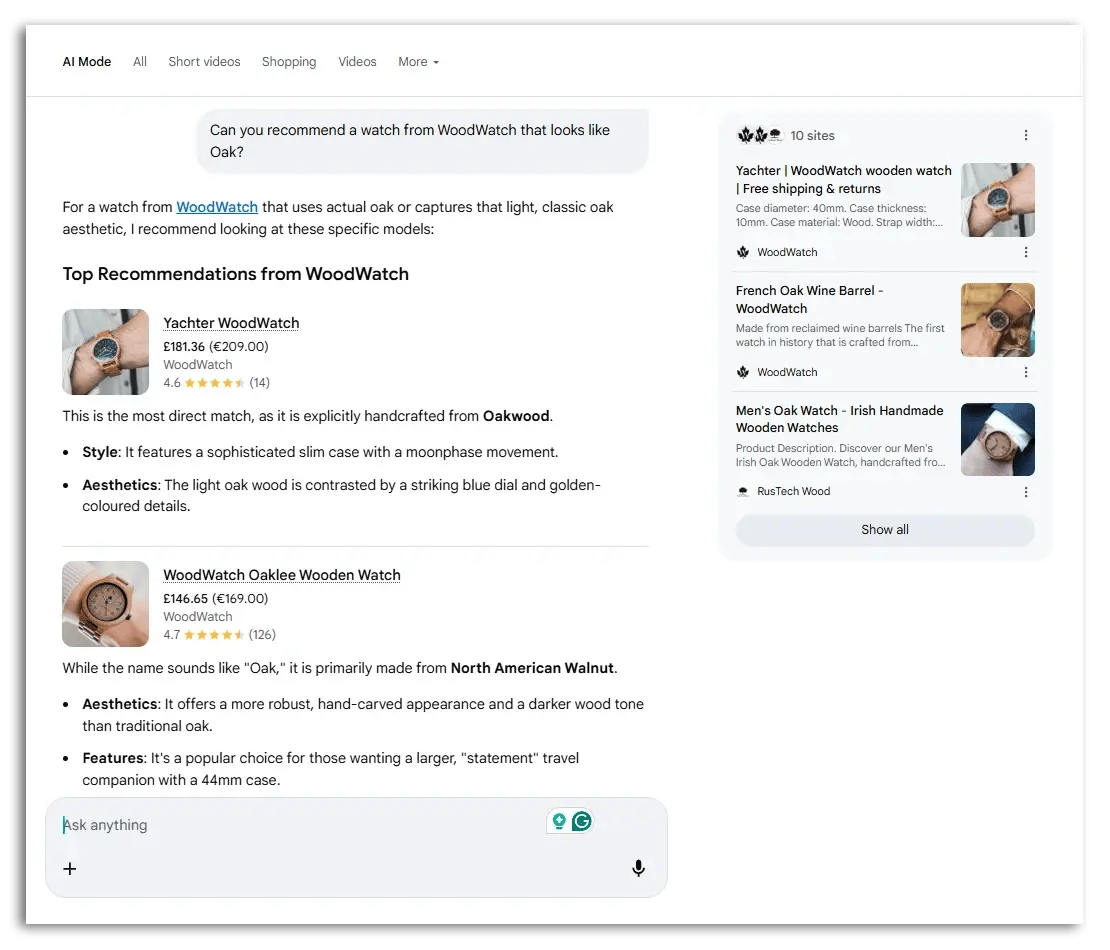
Source: WoodWatch
For shops to be considered by AI agents, it's crucial to provide structured data and detailed product information. Trust also remains a key factor: AI agents prioritise reputable sources for their recommendations. Therefore, trustworthiness should continue to be an essential component of your website.

It's great that you're using AI in your online shop, as this allows you to optimise your processes, reduce costs, and increase customer satisfaction. However, keep the points mentioned in mind to remain authentic. Ultimately, it's real people who are buying from you, not robots.
Weigh the opportunities and risks of AI against each other, observe the legal framework, rely on authentic customer reviews in your online shop, and above all, keep the needs of your target group in mind. This is how you, as a company, remain trustworthy in the age of artificial intelligence.
This article was originally published and translated from our German blog: KI im Online-Shop nutzen – ohne Vertrauen zu verlieren
05/05/26