


Collect and Display Reviews Effectively to Sell More
Learn best practices for collecting and displaying customer reviews to enhance your shop's visibility, boost conversions, and build trust with shoppers.
Every online shop wants loyal customers that come back again and again. But if your product is not unique, chances are that other online shops will sell it, and perhaps for an even better price. Therefore, your shop needs to be both worthwhile and memorable. In this article, we’ll give you 15 tips to ensure that customers only buy from your online shop and not from your competitors. We’ve broken our tips into four main categories:
Table of contents:
These first few tips focus on having a smooth purchase process, your customer service, and your after-sales communication. Optimising these elements will help you make a great impression and build up customer loyalty.
When shoppers want to buy something, they want everything to run smoothly. Otherwise, they’ll just visit another shop. Here are the important points:
If you don't do this, chances are the customer won't place a first order, let alone become a repeat customer.
Mistakes happen. That goes for both the company and the customer. This is where your customer service gets to shine.
Here’s an example to consider: A customer buys your product as a gift long before they actually give it to the end user. However, it turns out that the recipient already has this product, but now the return is not possible because the window for returns has expired.
Now, you can stick to the rules you've set, but it's often wise to be a bit lenient, especially if the problem is easy to fix.

Shutterstock/voronaman
If a replacement is necessary and you don’t want the customer to wait too long, you can ask them to email a proof of return. This way, you can immediately send a replacement product, for example.
It is also important that your customer service really addresses the customer's problem and is empathetic.
When your shop shows a bit of humanity, this will have a great impact on your online reputation.
Take care of your customer not only during the purchase process, but also after the order has been placed. That means making sure that returns are simple and clear.
Additionally, you must provide good service if the item breaks, even if this is months or sometimes years after purchase. That doesn’t mean offering a forever-guarantee, but you should be clear about the warranty and offer options for a quick repair or replacement.
Some online shops also offer the possibility to repair items (for a small price) after they’re no longer covered by the warranty.
When you’re there for them, even if there’s no more money to be made, customers will trust you more quickly and be willing to buy from you again.
The next few tips will focus on strengthening customer loyalty by building trust with your customers, being transparent, and communicating your values.
Your customer must have confidence in your online shop from the start, so make sure that this trust is visible throughout the customer journey! To boost customer loyalty, the following points are important:

In a world with many fake online shops, it is important that you continuously remind your customers that you’re reliable. Customers are willing to pay more with a business they trust. In fact, if products are offered too cheaply, this can actually lower confidence.
For Trusted Shops customers, we offer various widgets to show this trust throughout your online shop.
Recommended reading:
The Trusted Shops Trustmark + Buyer Protection for More Sales
Do everything you can to gain your customer's trust with every purchase. Reliability is the basis of customer loyalty.
Keep customers informed of updates and delays regarding their order. When you make a mistake, don't wait for the customer to realise it. Instead, proactively communicate what has happened and how you are going to solve it.
Do you sell products that could use some preparation? In your order confirmation, you may already give tips on how to make this as smooth as possible (e.g. “Get your power drill ready…”).
The customers who feel like you take care of them will immediately consider your business for their next purchase.

Some customers find it very important when a company has certain values. For example, it might not have been your intention, but if all your products are vegan, let them know. There’s an entire target group specifically looking for this.
Even if your products are produced in a fair way or are sustainable in some other way, this will attract a group of customers who appreciate your business more than your competitors, who might not have a strong opinion about it.
Recommended reading:
What Steps Can Your Business Take to Go Green?
This next round of tips deals with a bit more of the emotional side of online shopping.

Shutterstock/wk1003mike
It has been an important point for years and that will not change at all in the coming years: personalise your communication and create an emotional connection.
In a physical store, you have the staff with whom the customer builds a bond, but in an online shop, you don't have that. You have to rely on other, small, subtle tricks there.
For example, always address your customers by name and tailor your content to their behaviour and preferences. When you use remarketing, make sure that it is adapted to the preferences of this specific customer as much as possible. Are they subscribed to your newsletter? Only send what you specifically recommend for this customer.
You can also go a step further: Boost the unboxing experience by including small gifts, adding handwritten cards to the order, or sending unexpected upgrades.
Furthermore, you can strengthen the emotional connection by telling personal stories (perhaps on the card you send), posting the stories of customer experiences on social media, and by showing real people in your marketing campaigns.
Recommended reading:
Personalising the E-commerce Customer Journey
To ensure that customers are loyal to your business, they need to come into contact with your brand a lot.
This also means that you have to create a lot of valuable content to really help your customers.
Think of educational blogs, how-to videos, or free tools.
Do you sell clothes? Provide a clear size chart and photos of models with different sizes, so that you can see the products on different body types.
Do you sell food? Publish recipes with your products.
Do you sell toys? Show how the toy works with videos.
Customers find this very useful, so you will sell more and reduce the number of returns.
Here’s an idea that doesn’t get utilised very often: Offer users who create an account with you a kind of calendar where they indicate what their special days are.
You then (automatically) send a reminder a few weeks before that date, so that customers don't forget to place an order and they are more likely to visit your site again.
If you combine this with a discount, there is a good chance that the customer will come shopping with you again.
The data you have about your customers is a goldmine. You can get general information from it, such as which products are popular, but if the customers have created an account, you can do a lot more.
So it pays to advise your customers to create an account through a loyalty program, for example. This allows you to analyse your customers' behaviour and personalise their experiences.
You can also do A/B tests to see what works better with your customers. For example, whether offering a discount in your newsletter ensures more clicks, etc.
Recommended reading:
Data Mining on a Budget: How to Use it for Your Online Shop
This last group of customer loyalty tips involves creating a feeling of community.
In order to collect more reviews, you need to actively ask for reviews, which can be done through many review providers.
It is also important to do something with the feedback and to thank customers for their review. Therefore, actively respond to both positive and negative reviews. This can take a lot of time, so we recommend using a tool for this.
The Smart Review Assistant from Trusted Shops summarises review texts and generates a response for you, which you can customise or send directly. As a result, it will take you half the time, giving you more time to work on other things!

With the dashboards from Trusted Shops, you can quickly learn more about your reviews. For example, you can use the Sentiment Analysis to quickly find out what your customers are saying about various topics, such as your customer service.
Recommended reading:
How to Use Trusted Shops Dashboards + Analytics
Don't just ask for reviews, but make sure that customers really engage with your brand. So encourage them to share their experiences via social media, or start a conversation with them on social media.
Ask your audience questions, post fun social media posts, and keep the conversation going. Your customer feels special when you respond personally!
In addition, you can also post your reviews on social media or use them in other places in your marketing, such as your newsletter.

You build real customer loyalty by letting customers identify with your brand. Create a Facebook group and/or start a Reddit community (Subreddit).
To give the feeling of an exclusive club, you can:
You should also consider creating some branded apparel. Even if your focus is on other brands, you can still create some things for people to show their support for your brand. You can sell these products or occasionally give them away as freebies.
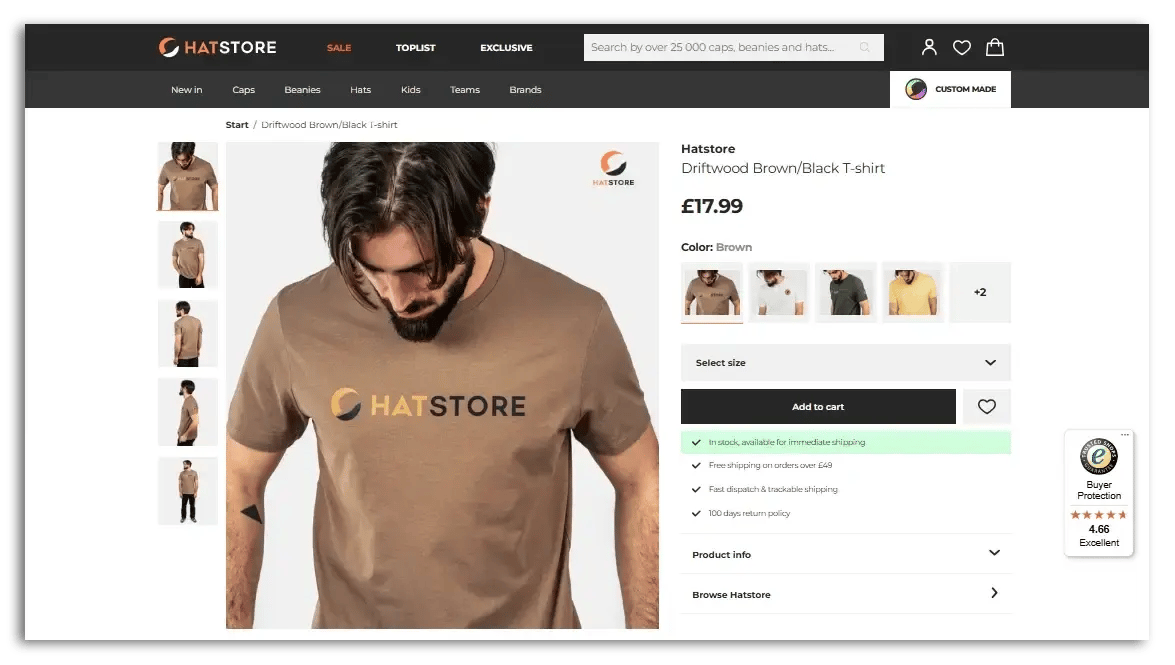
In the example above, we can see that although Hatstore usually focuses on caps for professional sports teams, they also create clothing for their own brand.
Picking up on the previous point: reward repeat purchases. This can be done through loyalty programs, such as points that can be saved and spent, but also exclusive benefits for members.
You can also send discounts on special days, such as the customer's birthday, or on special holidays.
What some online shops also do: offer subscriptions. You can subscribe for reduced shipping costs, or for products that need to be reordered every month, such as dog food. This makes it very attractive to keep coming back to you.
A good internal culture radiates through to the customer. When your employees are happy, your customers notice this too. You can hear it in the attitude of your customer service team. You can see it in how packages are packed. When your employees are happy, it ensures good word-of-mouth advertising.
You can also give your employees merchandise for daily use. Think of a hoodie so that your brand can be seen everywhere. When your employees proudly wear your logo, it says a lot about your company.
In this way, you turn your employees into ambassadors.
There are many ways to keep customers loyal to your brand, and you can't do everything at once. That’s why it’s important that you look at what is most feasible for your online shop and what will have the biggest impact in a short amount of time. This way, you can quickly boost your business and welcome those customers back to your online shop.
The key is: give your customer an unforgettably positive and reliable experience.
This article was originally published and adapted from our Dutch blog: Zorg dat je klant trouw blijft aan je webshop: 15 tips
12/05/26



After studying marketing & communication (Aventus, Apeldoorn) and journalism (Windesheim, Zwolle), Daniëlle worked for several years in Portugal in customer service for large online shops. Since 2019, she has been working at Trusted Shops as Content Manager Benelux, focusing on the Dutch-speaking market.
Read more